
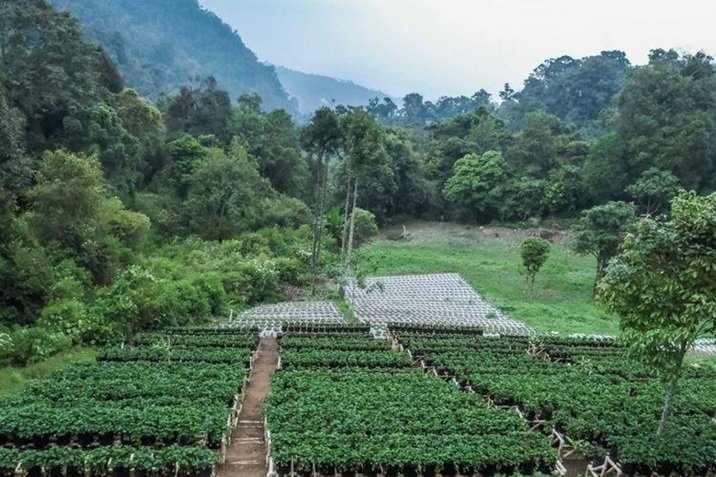
Alamendah Tourism Village, Rancabali, Bandung, is a portrait of one of the tourist villages that is able to utilize its potential optimally, to the point that it is included in the top 50 ADWI 2021 and is known as a center for strawberry agrotourism. With an average number of visitors coming around 300-500 people every month, this tourist village has experienced an increase in turnover, which previously was around 20 million, now reaching IDR 1.3 billion per month. However, behind the success of the Alamendah Tourism Village, there are great sacrifices made by its people. The tourist area, which was previously undeveloped and not very large, has now begun to expand to almost the entire area, even approaching land adjacent to conservation areas. The large number of land conversions from agricultural land and forests to tourist areas and residential areas has resulted in an increasing shortage of agricultural land and protected areas. Where, Alamendah Village is also the smallest area compared to other villages with an area of only 15.91 km2 or around 10.30 percent of the total area of Rancabali District. Despite the sacrifice of land conversion, the income obtained is profitable for the people of Alamendah Village. This condition occurs because the tourism sector is able to promise a fast turnover of money, while when it comes to farming, the results obtained are very uncertain. In fact, several areas of rice fields were actually sold to be built for accommodation purposes. People who used to farm have turned into lodging employees, or at least look after parking in places that used to be planted with agriculture. Even though Law Number 32 of 2009 concerning Environmental Protection and Management has mandated the principles of prevention and precaution, supervision of the implementation of Environmental Impact Analysis (AMDAL) is still very weak. There is a need for village planning supported by land use mapping to develop tourism villages further. In the planning process, the village master plan has an important role in planning the direction of village development, starting from spatial management to analyzing disaster vulnerability. From the village master plan an action plan will be drawn up, which areas must be maintained to prevent land conversion, when physical development will begin and institutional governance to ensure this village plan is implemented. In an effort to achieve the success of the Alamendah Tourism Village master plan, the participation of various parties is required, such as the regional government, village government, surrounding communities, and stakeholders in the tourism and village infrastructure sectors. A good village master plan will be useful in improving the economy and community welfare. Apart from that, the village master plan will minimize excessive environmental damage, especially due to land conversion. If the village master plan can be implemented, then the tourist village can maximize its potential in the long term. The Amalendah Tourism Village has shown that tourism villages are capable of becoming a major economic driver. Starting from a turnover of 20 million to 1.3 billion per month, from an ordinary little-known village to the top 50 best tourist villages in Indonesia. However, big sacrifices are needed to achieve this, namely shrinking agricultural land, reduced protected areas, and farmers changing their livelihood to becoming laborers. If spatial planning, community participation and AMDAL supervision are carried out seriously, Alamendah Village can develop sustainably. If not, the existence of the Alamendah Tourism Village will be threatened and it will no longer be known in the community. So, the choice is in the hands of the current generation. Will it make the tourist village reach its maximum potential, or will it just enjoy temporary benefits that will be lost over time.
Potential and Challenges of Alamendah Tourism Village: Maintaining Sustainability in the Midst of Development
- Administrator
- 06 August 2026